SEO Keywords for Churches: What to Target and Where
Ask what the people your church is equipped to serve are looking for. Give them a useful answer. Then make that answer easier to find.
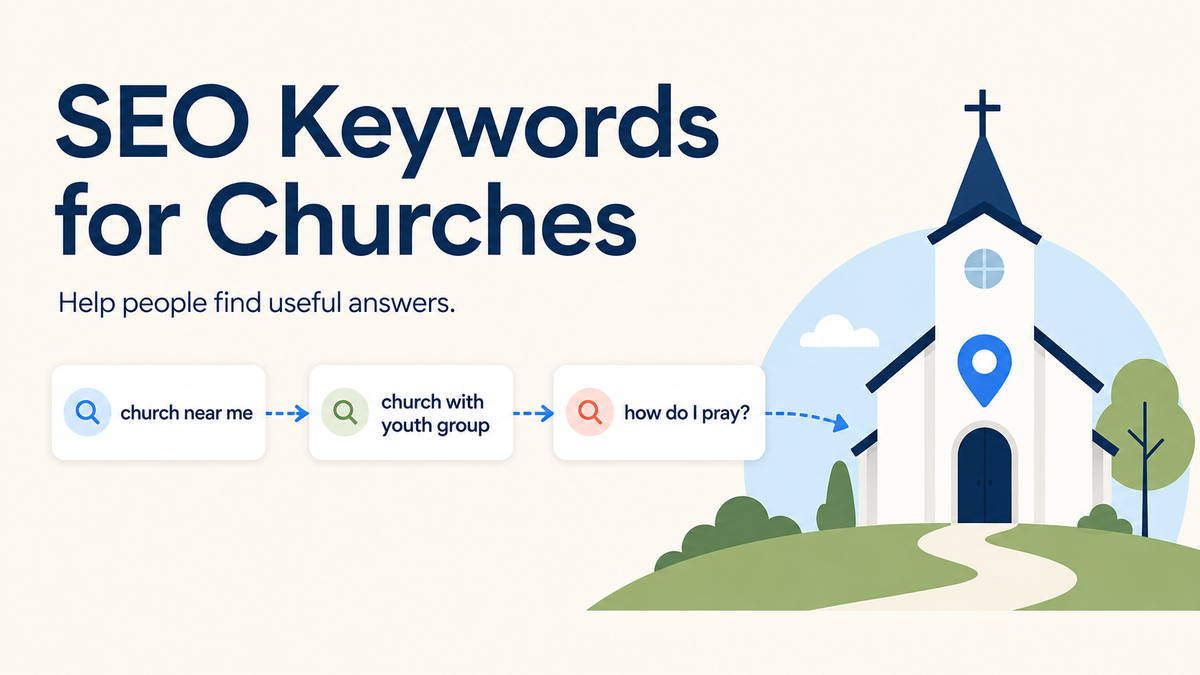
When I see a church website ask, “Are you looking for a church near me?” I want to stop and ask who that sentence is for.
Nobody talks that way.
That church is trying to use the right phrase. I understand the goal. But a keyword is not a password you type into your website so Google lets you rank.
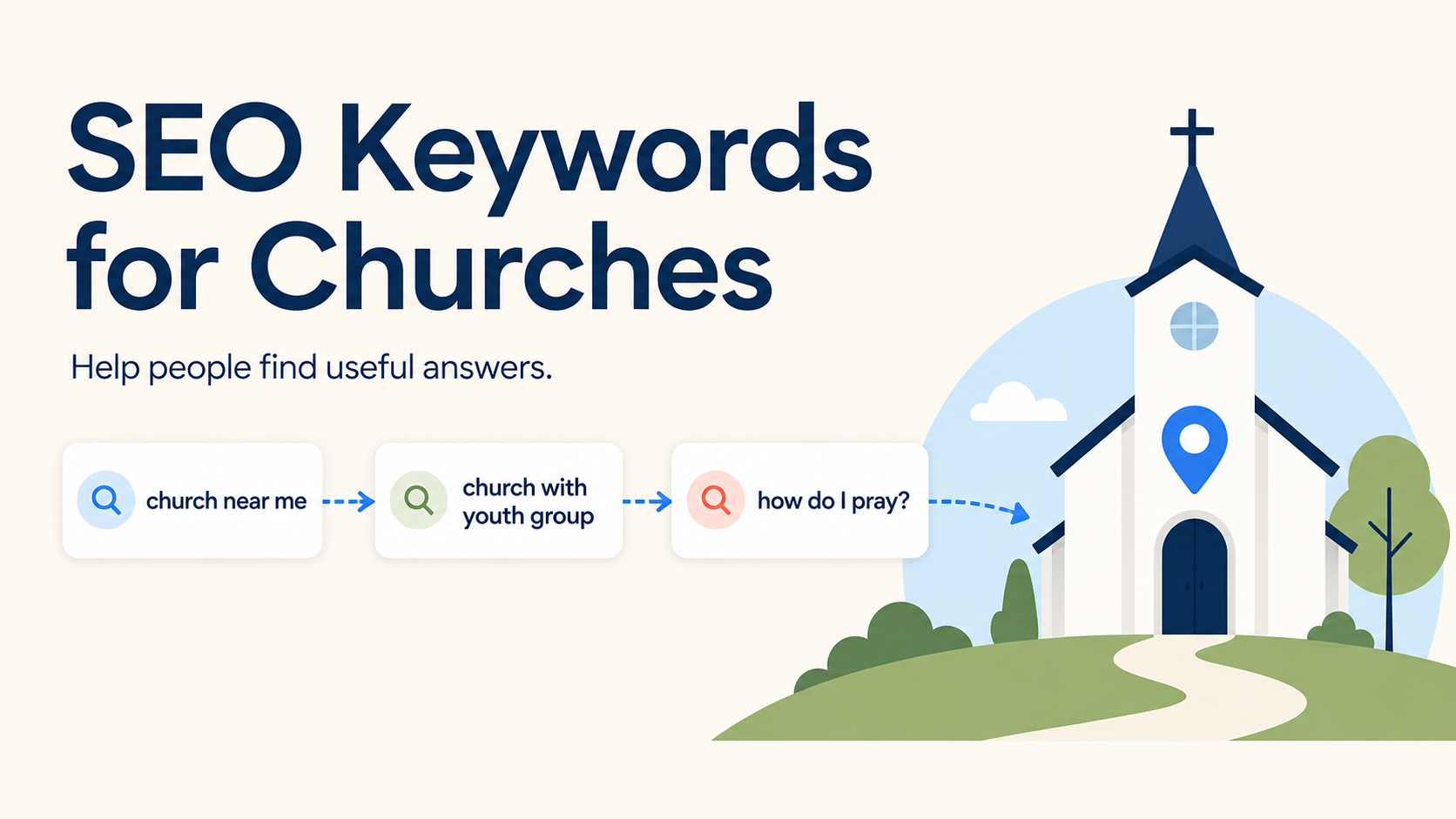
The best SEO keywords for churches describe where the church is, what it offers, and the questions it can answer. That includes phrases like “church in Fort Worth,” “church with a youth group,” and “how do I start going to church?”
The useful question is what someone needs when they search—and whether your page helps them.
Church SEO keyword examples, grouped by what people need
A keyword can be a word, a phrase, or an entire question. These examples are starting points to adapt to your church, not a universal list to paste into your website.
| Search need | Example keywords | Where to answer |
| Find a nearby church | church in Fort Worth; churches near me; Baptist church in Nashville | Homepage, campus page, Google Business Profile |
| Find a ministry or service | church youth group near me; Wednesday night church service; church with Spanish service | Relevant ministry or service page |
| Learn about a church they know | church name + service times; church name + beliefs; church name + reviews | Visit, about, beliefs, and profile information |
| Get help with a faith or life question | how to pray; what does God’s provision mean; what does the Bible say about grief | Useful teaching article or resource |
Your church probably has opportunities in more than one group. They don’t all deserve the same page or the same invitation.
Someone searching for a Wednesday service needs the time, location, and an explanation of what happens. Someone asking how to pray needs an answer they can understand and use.
A “Plan Your Visit” button can help the first person. It probably shouldn’t be the entire response to the second.
Start with search intent
Search intent means what someone is trying to accomplish.
“Church near me” tells you that location matters. It doesn’t tell you the person’s denomination, family situation, or whether they want to attend this weekend. They could be comparing options or looking for somewhere to go in an hour.
“Church with special needs ministry near me” gives you more context. This person has a particular need. Your page should explain what support is available and how to ask questions before arriving.
That doesn’t make the more specific search automatically more valuable. It makes the need easier to understand.
Before choosing a keyword, ask:
- Does this describe something our church actually offers?
- What would someone expect to find after clicking?
- Can we give them a useful answer?
- What would be a reasonable next step?
Search volume can help you understand demand. It cannot answer those questions for you.
Four types of church keywords worth considering
1. Local discovery: help people find your church
Start with your identity and location.
Your homepage should include your church’s name as readable text, your city, and clear information about where and when you meet. If your denomination is relevant to how people find and understand you, make it easy to find.
For a church with multiple campuses, each location needs useful, accurate details.
You can write naturally, “Grace Church is a Baptist church in Fort Worth.”
You don’t need to manufacture sentences around “church near me.”
Local visibility also extends beyond your website. Google describes local results in terms of relevance, distance, and prominence—how well a place matches the search, how close it is, and how well known it is. Google’s local-ranking guidance. That makes accurate Google Business Profile information, appropriate categories, genuine reviews, and relevant links worth attention. You cannot write your way out of the distance between your church and the person searching.
2. Ministry fit: help people see whether you can serve them
Your ministries can reveal some of your most useful keyword opportunities.
Think about youth groups, young adults, recovery, Spanish-language services, food assistance, or other ministries your church actually provides.
Then describe them in the language someone outside your church would use.“Movement Students” might mean something to your congregation. A parent who has never visited needs to know it is a youth group.
Keep the name. Add the explanation. A heading such as “Movement Students: Our Youth Group in Fort Worth” gives the ministry’s name some context. The rest of the page should explain the ages served, meeting schedule, location, what to expect, and who can answer a parent’s questions.
At my previous church, we noticed searches in Google Search Console related to Wednesday-night services and activities. We built a page specifically around what happened on Wednesdays, and those searches began performing better.
What mattered was noticing a need and giving it a useful destination.Your homepage can introduce your ministries. A dedicated page gives you room to answer the questions someone has about one of them.
And be honest about the ministry itself. Don’t optimize for a young-adult community you don’t currently have. Visibility creates expectations. Your church needs to be able to meet them.
3. Branded searches: help people who have already heard of you
Some people will search directly for your church.
They may want your service times, beliefs, denomination, pastor, address, or reviews. They may be considering a visit, or they may already attend.
Search your church’s name and city. Then add “service times” or “beliefs.”
Can someone find the right answer? Do old schedules or outdated names appear on pages and profiles your church controls?
Keyword research can uncover this kind of friction. It isn’t only about introducing your church to strangers. It can also help someone take the next step after a friend has invited them.
4. Faith and life questions: help people before they consider attending
Your pastor already teaches about things people ask questions about: prayer, forgiveness, parenting, grief, generosity, and purpose.
That teaching can become useful website content.
A sermon about God’s provision might contain a clear answer to “What does God’s provision mean?” A message about forgiveness might help someone asking how to forgive a person who hurt them.The sermon series name may not communicate that answer. “Unshakable: Week 7” needs context for someone encountering it for the first time.
Choose a useful question from the message. Write a standalone article that answers it, preserves the pastor’s meaning, and links to the full teaching.
A transcript can help people access a sermon. An article gives you the chance to edit repetition, explain references, add headings, and make one answer easier to find—more on that in my guide to creating content for your church.
This isn’t a reason to let a keyword tool set your preaching calendar. Start with the teaching and pastoral experience your church already has. Use search research to understand how people express the questions that teaching addresses.Also recognize the audience. A national faith question may reach people who will never attend your church. That can still be worthwhile ministry. It is a different outcome from helping a nearby family find your youth group.
How to find keywords for your church
You can begin without an expensive SEO subscription.
Start with questions people already ask
Ask your ministry leaders, office staff, and welcome team what people want to know.
Do parents ask which ages can attend? Do newcomers ask whether you offer a midweek service? Do people struggle to understand a ministry’s name?
Write down recurring questions in plain language. You are looking for patterns, not details from someone’s private pastoral conversation.
Check Google Search Console
Search Console shows queries that have brought your website impressions and clicks in Google Search.
Open the search performance report and look for relevant phrases. Then inspect which page appears for them.
Pay attention when people are finding a page that only partly answers their question. Sometimes the best next step is improving that page. Sometimes a distinct ministry needs its own page.
Look at a meaningful period rather than treating one impression as a trend. Search Console also doesn’t show every query, so an absent phrase is not proof nobody searches for it.
Search the phrases yourself
Look at the results for a few promising searches.
Are you seeing nearby churches, ministry pages, videos, or articles answering a question? Suggestions and related questions can help you identify language to investigate.
This checks what people might expect, not permission to copy another church’s content. For local searches, remember that results vary by location. What you see from the church office is one view.
Use keyword tools for perspective
Keyword tools can estimate search volume and competition. They help compare opportunities, but the numbers need context.
National volume is not the number of people near your church. A tool may also report little or no data for a very specific local phrase.
That should lead you to check the need, not automatically dismiss it.
AI tools can help brainstorm ways people might phrase a question. Treat those ideas as suggestions to verify, not measured search demand.
Match each keyword topic to a useful page
One page can rank for many related phrases. You don’t need separate pages for every arrangement of the same words. Google explicitly says its language systems can connect pages with queries even when the exact terms aren’t used. Google’s SEO starter guide.
Build around a coherent need.“Church in Fort Worth” and “Fort Worth church” may belong on the same page. A youth group and a recovery ministry deserve different explanations. Here is a practical map:
| Topic | Useful destination | Details the reader needs |
| Your church and city | Homepage or campus page | Identity, location, service times, what to expect |
| Youth group | Youth ministry page | Ages, schedule, location, activities, parent contact |
| Wednesday services | Midweek page when there is a distinct program to explain | Current schedule, available activities, who can attend |
| Spanish-language worship | Service or ministry page | Language, time, location, contact information |
| Easter service | Current event page | Actual dates, times, location, visitor details |
| A question about prayer | Teaching article | A clear answer, relevant Scripture, practical help |
Use a descriptive page title and main heading. Include the topic and location where they help the reader, then write naturally. Link to the page from relevant parts of your website. For a hypothetical youth page, “Youth Group in Fort Worth | Grace Church” tells someone more than “Movement.” But a better title doesn’t make up for missing meeting times or an unanswered contact form.
Make your wider online presence tell the same story
If your website describes a welcoming kids ministry, help people understand what that means.
Explain the ages served and the check-in process. Keep service details current. Share useful information on your social profiles. Invite people to leave honest reviews of their experience without telling them what to write.
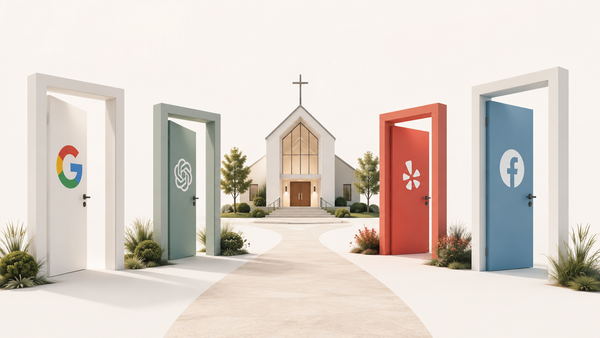
These places help people discover and evaluate your church. They should provide consistent facts and a recognizable picture of your ministry.
This does not mean every caption needs a city-and-keyword formula. It also doesn’t establish that repeating a phrase on social media makes Google or an AI tool rank your church.
Clear communication is useful on its own. I explore that wider picture in Stop Calling Your Church Website the Digital Front Door.
Where I would start this week
Choose one meaningful improvement.
First, make sure someone can find your church’s location, service times, and identity.
Then choose one ministry your church is equipped to serve well. Identify the question or search phrase that describes it. Improve the page that should answer it.Once those foundations are useful, choose one question from your existing teaching and create a resource around it.
For every idea, consider relevance, intent, and whether you can help. Use search volume as context.
Over time, check whether the page earns relevant impressions and clicks. Where you can measure them, also look at useful actions: someone contacting the ministry, reading a related resource, or finding visit information.
Those actions help you understand whether the page is useful. They don’t prove that an SEO change caused attendance growth or a spiritual outcome.
Common questions about church SEO keywords
What are the best SEO keywords for churches?
Start with location and church identity, then relevant ministries and the questions your church can answer well. “Church in your city,” a denomination-and-location phrase, and specific ministry searches are useful starting points to investigate.
How many keywords should a church page target?
Give the page a clear purpose and cover the related questions and phrases naturally. You don't need to restrict a page to one exact keyword.
Should I put “church near me” on our website?
You don’t need to force it into your copy. Clearly explain where your church is and what it offers, and keep your local profile information accurate.
Should every sermon become a blog post?
No. Choose messages with a useful standalone question or topic, then edit them for a reader. Keep the teaching accurate and have the appropriate ministry leader review it.
There is a person on the other side of the keyword
Someone searching for a nearby church may be looking for community. Someone asking what the Bible says about grief may be hurting.
The keyword shows up in a report as a row of data. The need behind it deserves more attention.
Ask what the people your church is equipped to serve are looking for. Give them a useful answer. Then make that answer easier to find.
Want more practical help making your church easier to find online? Subscribe to The Content Pastor for guidance on church SEO, content, and AI visibility.