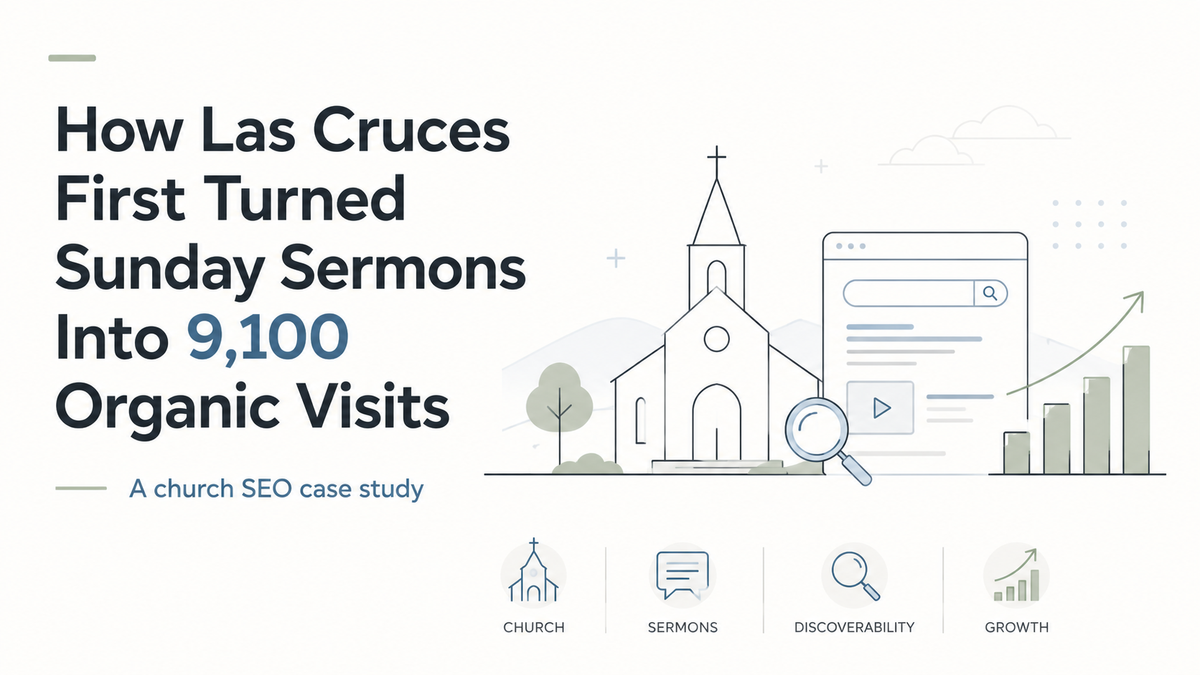
How Las Cruces First Turned Sunday Sermons Into 9,100 Estimated Monthly Organic Visits
A website rebuild and sermon-to-search content strategy helped a thriving New Mexico church become easier to find—both locally and nationally.
Las Cruces First did not have a ministry problem.
The Assemblies of God church was actively serving Las Cruces, New Mexico. It operated a food pantry, produced worship services, preached thoughtful sermons and welcomed nearly 1,600 people each week.
But someone who encountered the church online would have seen a different story.
The church’s website was outdated, visually flat and difficult for Google to understand. Important information was buried. Most of the written content was embedded inside Canva graphics. Although the church had a strong physical presence in its community, its website received only an estimated 100 to 300 organic visitors per month.
A thriving church was practically invisible online.
Over the next year, I worked with Las Cruces First to rebuild its website, improve its local search visibility and turn Pastor David Iglesias’ sermons into articles designed to answer questions people were already asking online.
By August 2024, Semrush estimated that the church was ranking for 350 keywords and receiving 9,100 monthly organic visits.
But the most important result was not the traffic.
The project demonstrated what can happen when a church makes its existing message easier to find beyond Sunday morning.
The results at a glance
Client: Las Cruces First
Location: Las Cruces, New Mexico
Denomination: Assemblies of God
Engagement: November 2023–February 2025
During the engagement:
- Estimated organic traffic grew from approximately 100–300 monthly visits to more than 5,000 during several peak months.
- Semrush estimated 9,100 monthly organic visits on August 12, 2024.
- The site ranked for approximately 350 keywords at its peak.
- Semrush estimated the equivalent value of that organic traffic at $14,100 per month.
- The church began appearing on page one and in the local map pack for relevant Las Cruces church searches.
- Average weekly attendance increased from 1,597 in the second quarter of 2024 to 1,815 in the third quarter.
- The church reported 297 baptisms during 2024.
The website work cannot be credited as the sole cause of the attendance or baptism growth. Those outcomes belong to the church’s pastors, staff, volunteers and broader ministry efforts. And lets not forget the Holy Spirit.
What the data does show is that the church’s digital visibility and in-person attendance moved in the same direction during the same period.
A strong church hidden behind a weak website
My first conversation with Las Cruces First happened in November 2023.
Pastor David Iglesias was serving as executive pastor at the time. His wife had previously worked with my dad in Fort Worth, and after hearing about my work with churches, she connected us.
Initially, the church believed it had an output problem.
It had recently lost someone who had been helping with social media and digital communication. The staff knew it needed to publish more consistently, so the expected solution was primarily more social media content.
Once I reviewed the website, however, it became clear that publishing more social posts would not address the underlying issue.
The website had very little depth. It relied heavily on a white background, inconsistent fonts, weak color contrast and Canva graphics containing text that should have been written directly onto the page.
The approach made the website easier for staff members to edit, but it made the content harder for Google to read and understand. It also created a less accessible experience for visitors.
Other problems included:
- Outdated information in the resources and giving sections
- Events appearing more prominently than service times
- A navigation menu organized without a clear visitor journey
- Only three or four meaningful pages available for Google to index
- No established analytics foundation for evaluating technical health
- Limited information for people deciding whether to visit
The site was not especially confusing. It was simply shallow.
A person might click once or twice, fail to find a compelling reason to stay and leave without understanding what Las Cruces First was really like.
The actual church was passionate about its city and actively serving its community. The website made it appear bland and inactive.
As Pastor David later described it:
“Before working with Luke, our church’s website was out of date, stale, arbitrary and dysfunctional.”
This was not a situation where changing a headline or adding a few keywords would be enough.
Trying to patch the old website would have been like sealing holes in a ship that was already halfway underwater.
Las Cruces First needed a new foundation.
Rebuilding the church’s digital lobby
Work on the new website began in late December 2023, and the site launched in February 2024.
The goal was not merely to produce a more attractive design. It wasn't to be a "digital front door." Rather, it was meant to be a digital lobby.
The new website needed to accomplish three things:
- Accurately represent the church
- Help potential visitors find important information
- Send clear signals to Google about who the church was, where it was located and whom it served
I worked with Pastor David and the church staff to develop stronger written content for the homepage and ministry pages. Existing information about groups was reorganized into a clearer groups page. Text that had previously been locked inside graphics was placed directly on the website so people and search engines could read it.
Relevant local language was also added naturally throughout the site. The goal was not to stuff “church in Las Cruces” into every paragraph. It was to remove ambiguity.
Google needed to clearly understand that Las Cruces First was a church serving people in Las Cruces, New Mexico.
The new website also reflected the needs of several potential visitors:
- Someone who had recently moved to Las Cruces
- A young adult looking for community
- Parents evaluating children’s ministry
- An older couple searching for a new church home
- Someone unfamiliar with Christianity
- A person going through a difficult season and looking for hope
Instead of organizing the website primarily around internal preferences, we built it around what those people needed to know.
Making the decision to visit feel safer
One of the most important pages was the Plan Your Visit page.
Visiting a church for the first time can be uncomfortable. People may wonder where to park, what to wear, where to take their children and whether they will stand out.
A church website should reduce that uncertainty before someone ever arrives.
The Las Cruces First page answered practical questions about clothing, parking, food and the overall experience. It even mentioned the breakfast burritos served at the church.
Photos showed real people serving outside on the parking team and welcoming guests inside the building. Instead of relying entirely on staged promotional language, we also added genuine reviews from the church’s Google Business Profile, including the reviewers’ names.
Those reviews provided social proof from people who had already taken the step a potential visitor was considering.
The page was designed around one clear call to action:
Plan Your Visit.
The purpose was not to pressure someone. It was to make the next step feel understandable and safe.
“The website is truly indicative of who we are,” Pastor David said. “Our mission is reflected in the content. The multimedia is engaging.”
The website created the foundation. The sermons created momentum.
The rebuilt website improved Las Cruces First’s ability to compete for local searches. By May 2024, estimated organic traffic had increased to approximately 500 monthly visits.
That was meaningful progress, but it was only the beginning.
The next stage was an experiment built around a question that had shaped much of my work:
Could a sermon become evergreen search content without losing the pastor’s voice or reducing the message to a generic summary?
Las Cruces First already produced high-quality content every Sunday.
The church recorded its sermons, published them to YouTube and retained the pastor’s notes. It did not have a lack-of-content problem.
It had a distribution and publication problem.
Most sermon repurposing stops with a few social graphics, a short video clip or an AI-generated Bible study guide. Those formats can be useful, but they usually disappear quickly into a feed or remain visible only to people who already follow the church.
Search content operates differently.
A helpful article can continue answering questions months or years after the sermon was preached.
Turning sermons into articles—not transcripts
The sermon-to-content process began with Pastor David’s first message series after he became lead pastor.
Before publishing anything, I prepared three or four articles so the church would have a content library and a consistent schedule. Once that foundation was ready, we began publishing approximately one article per week.
My process involved:
- Pulling the transcript from the sermon’s YouTube video
- Reading and annotating the full message
- Reviewing Pastor David’s sermon notes when available
- Identifying his strongest quotes, stories and original insights
- Researching the questions and keywords people used around the topic
- Restructuring the material for someone reading rather than listening
- Adding biblical and explanatory context when needed
- Retaining Pastor David’s tone and theological intent
My journalism background played an important role.
I did not want the articles to read like automated transcripts or glorified sermon summaries. Each one needed a clear angle, a useful structure and a reason for someone outside the congregation to read it.
Not every sermon needed to target a high-volume keyword. Some messages were based on niche Bible characters or themes with limited search demand.
That was an important lesson during the project:
Not everything has to be aggressively optimized. Sometimes valuable content can simply exist.
But when a sermon aligned with a question people were actively searching, the results could compound quickly.
The article that changed the trajectory
The second article we published was titled:
“What Is God’s Provision—and What Is It Not?”
The article was based on Genesis 22:1–18 and a sermon in which Pastor David discussed Abraham’s obedience and God providing a ram in place of Isaac.
But it was not merely an explanation of the passage.
The article opened with a familiar illustration from Star Wars, defined provision in Pastor David’s own words and explored several biblical examples. It then incorporated his personal testimony about moving from the Dallas–Fort Worth area to Deming, New Mexico, to serve in ministry despite being told his initial salary would be zero.
The article also addressed the difference between God’s provision and prosperity theology before pointing readers toward the gospel as God’s ultimate provision.
That combination made the article work:
- It answered a clear question.
- It used an original definition from a pastor.
- It included a personal story.
- It explained Scripture.
- It addressed a common theological misunderstanding.
- It gave the reader a practical and spiritual takeaway.
This was not content created merely to target a keyword. It was authentic pastoral teaching structured in a way that search engines and readers could understand.
Google eventually displayed Pastor David’s definition inside a “People also ask” result for searches related to the meaning of provision:
“Provision is the arrangement or preparation beforehand as for the doing of something, the meeting of needs, the supplying of needs.”
Suggested image placement: Insert the Google “People also ask” screenshot here.
The article began ranking for broad searches including:
- Provisions
- Provision
- Provision meaning
- Define provisions
- God’s provision
According to the August 2024 Semrush report, the article accounted for most of the site’s national organic traffic at the time.
It also demonstrated something important: a local church could compete for biblical and theological questions that were often being answered by publishers, software companies and national ministry brands.
The church’s sermon had become a discoverable resource for people who had never attended Las Cruces First—and might never have otherwise encountered Pastor David’s teaching.
The moment the experiment worked
I was working from a coffee shop when I saw the traffic spike.
The timing immediately made sense. The article had aligned with a high-volume topic, and a Google algorithm update had increased its visibility.
Based on the search demand and the queries for which the page was appearing, the numbers were believable.
I contacted Pastor David immediately.
The staff was excited about the traffic, especially when I explained what it might have cost to generate a comparable number of website visits through paid advertising.
By August 12, 2024, Semrush reported:
- 350 ranking keywords
- 9,100 estimated monthly organic visits
- $14,100 in estimated monthly traffic value
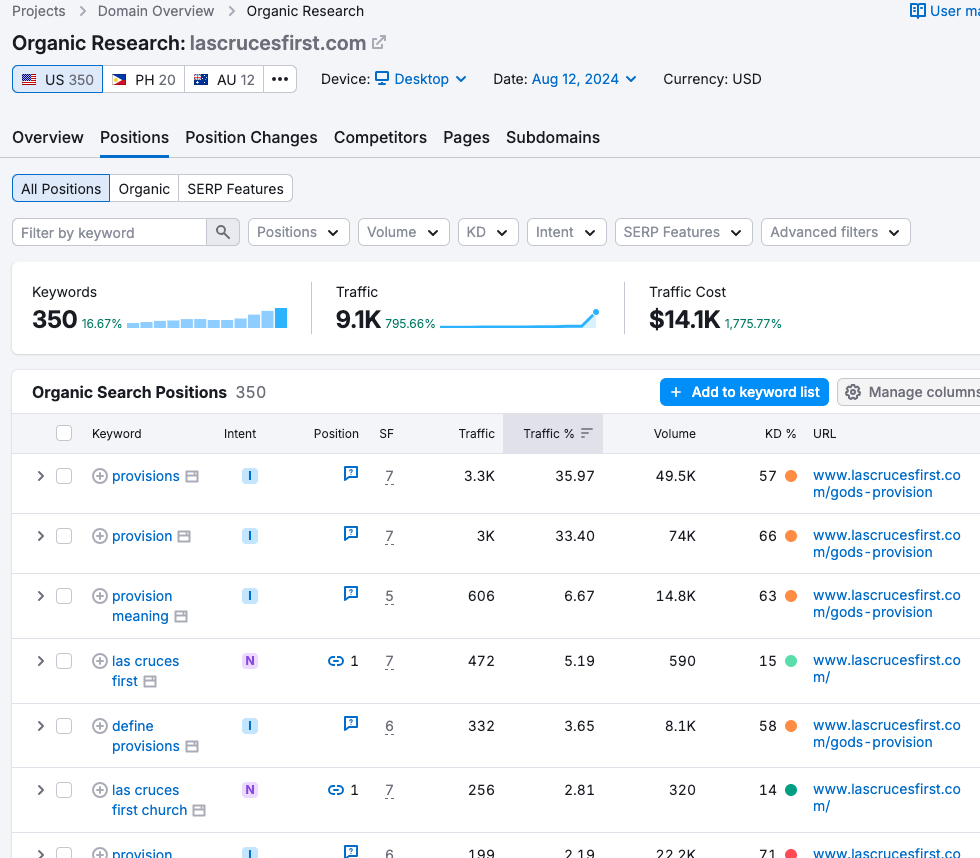
The 9,100 figure represented a peak estimate rather than a guaranteed or permanently sustained number. A Google update contributed to the rapid increase, and the provision article generated a significant percentage of the traffic.
Even with those qualifications, the broader trend was clear.
Traffic had started around 100 to 300 estimated monthly organic visits. It reached approximately 500 by May and exceeded 5,000 during multiple months after the church began publishing sermon-based articles.
The successful article may have produced the largest spike, but it was not the only sign of progress. The domain continued ranking for a growing collection of lower-volume biblical, generosity and tithing-related searches.
The site was developing topical depth.
Digital growth during an unusual season of church growth
Website traffic was not the only metric moving upward.
Las Cruces First averaged 1,597 people in weekly worship attendance during the second quarter of 2024. In the third quarter, that average increased to 1,815.
That represented growth of roughly 14% during the summer—a season when many churches ordinarily experience an attendance decline.
I cannot say that organic search caused that increase. The church did not have the attribution systems needed to determine exactly how every visitor found it.
But the parallel movement matters.
While the church became more visible online, more people were also attending in person.
Las Cruces First later reported nearly 300 baptisms across its 2024 baptism services.
Those baptisms were the result of the Holy Spirit working through pastors, ministry leaders, volunteers, personal invitations, community outreach and many other factors. It would be inappropriate to reduce those stories to a marketing metric.
For me, however, they provided the clearest reminder of why church visibility matters.
The marketer in me was proud to see traffic and attendance grow.
The Christian in me cared far more about people making public commitments to follow Jesus.
The goal was never traffic for traffic’s sake. It was to remove obstacles between people looking for hope and a church prepared to welcome them.
Managing a pastoral transition without losing momentum
The website project also took place during a major leadership change.
The lead pastor accepted a position at another church, and David moved from executive pastor to lead pastor.
Leadership transitions can easily derail communication projects. In this case, the transition did not change the goals or substantially delay the timeline.
Because David had already been my primary contact, we had an established working relationship. As his responsibilities increased, I worked more frequently with his executive assistant.
Consistent communication allowed the project to continue moving forward.
Pastor David later described the partnership this way:
“Initially we didn’t know exactly how it was going to work because we had never partnered with a content specialist, but over a very short time we’ve discovered that Luke has proven to be a huge asset to the church.”
He highlighted my responsiveness, communication and ability to understand the church’s culture.
“I would highly recommend Luke to all pastors and churches,” he said. “Because he has a heart for ministry first, he understands that an online presence is far reaching and critical in spreading the Gospel in our world today.”
What happened when the publishing stopped
The engagement ended in February 2025 as the church reassessed its budget and priorities.
I was disappointed. I had already developed a second-year strategy that would have expanded the work into social content, visitor funnels and emerging AI-search opportunities.
Still, I kept the website operational until the church was ready to transition.
A different agency launched another website in March 2025. I provided the sermon articles to the church, but they were not republished on the new site.
Within days, Semrush’s organic traffic estimate dropped sharply.
The church retained some of its local visibility, but the national traffic generated by its sermon content largely disappeared with the articles.
That decline does not mean every church must publish forever simply to protect a traffic graph. It does demonstrate that digital content is an asset.
When a valuable page is removed without being migrated, redirected or republished, the visibility attached to it can disappear with it.
Consistency allows content to compound.
Maintenance protects what has already been built.
What I would do differently today
Las Cruces First was my first client, and the project shaped the systems I now recommend to other churches.
Today, I would strengthen the work in several ways.
I would optimize the Google Business Profile alongside the website rebuild and use local rank-tracking tools to visualize visibility across the Las Cruces area.
I would establish reporting from the beginning, including monthly summaries that connected website performance to meaningful ministry indicators.
I would also ask the church to track:
- First-time guests
- How visitors heard about the church
- Plan-a-visit form submissions
- Calls and direction requests
- New-member participation
- Event registrations
- Baptisms and discipleship steps connected to recent visitors
Better measurement would have helped church leadership see the momentum more clearly and distinguish local visitor growth from national educational traffic.
I would also preserve more visual documentation, including screenshots of the old website, the rebuilt pages and ranking changes over time.
Most importantly, I would spend time on-site creating content with the church’s staff and congregation. Sermons are only one source of meaningful content. Member testimonies, community partnerships and stories of local impact can give people an even clearer picture of what God is doing through a church.
What Las Cruces First proved
This project proved that churches do not necessarily have a lack-of-content problem.
They have a distribution and publication problem.
Pastors invest hours every week studying Scripture, developing messages and teaching their congregations. But after Sunday, much of that work is buried inside a video archive and labeled with a sermon-series title that no one outside the church would search for.
A transcript is not a content strategy.
A few social clips are not a long-term distribution system.
A sermon becomes more valuable online when it is structured around the questions people are asking, published in a format search engines can understand and made easy to find after Sunday has passed.
That does not mean pastors need to become professional marketers or spend every Monday rewriting their sermons.
It means they may need the right partner.
Marketing is not a bad word. It is simply the activity of communicating something valuable to the people who need it.
For a church, the objective is not to manipulate people or chase attention.
It is to make the mission clear, remove unnecessary barriers and help people find a place where they can encounter hope.
The sermon was never the problem.
People simply could not find it.
Your sermon should live beyond Sunday
Every week, your church creates teaching that could continue helping people long after the final service ends.
The question is whether that message will disappear into an archive—or become a resource people can discover when they need it most.
Subscribe to The Content Pastor newsletter for practical insights on church visibility, sermon repurposing, SEO and helping more people find your church.