How to Improve Your Church’s AI Visibility in 3 Steps
Succeeding in AI search requires thinking beyond rankings and toward complete brand visibility.
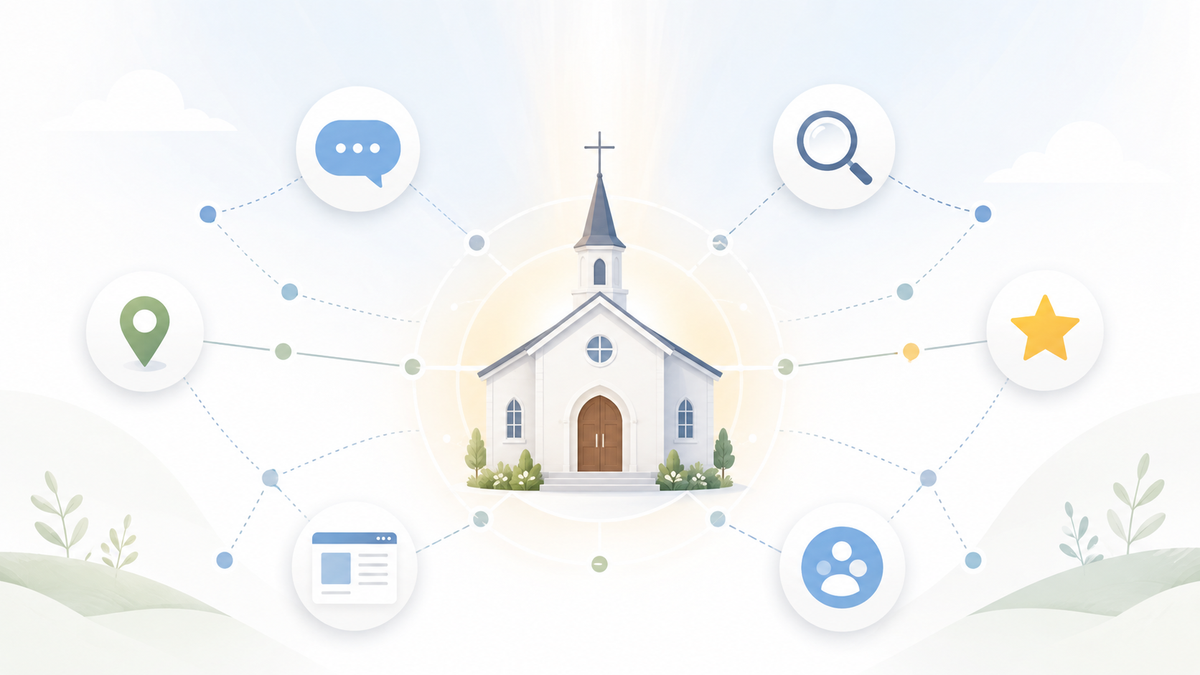
If you want your church to show up more often when someone asks ChatGPT, Gemini, or another AI tool for a church recommendation, you need to think bigger than traditional SEO.
You can’t simply add the phrase “family-friendly church in Fort Worth” to your homepage 15 times and expect ChatGPT to start recommending you to every family moving to Fort Worth.
AI visibility is a reputation problem.
AI tools need to understand who your church is, what you’re known for, who you serve, and whether there is enough evidence across the internet to support recommending you. That means your strategy needs to happen in three stages:
- Know what you want to be known for.
- Talk about it consistently.
- Get other people to talk about it too.
Or, put another way: Clarity → Consistency → Corroboration.
Andrew Holland, one of my favorite people to follow on the changing search landscape, is pushing a similar idea in the business world. He argues that succeeding in AI search requires thinking beyond rankings and toward complete brand visibility: positioning, content, PR, social, mentions, reviews, and the broader network of information surrounding a brand.
This concept translates well for churches.
Step 1: Know What You Want Your Church to Be Known For
Before you worry about ChatGPT understanding your church, your church needs to understand itself.
What are you known for?
Church branding strategist Mark MacDonald calls this your “thread.” He defines a thread as a short phrase—roughly three to five words—that positions you differently and gives your communication guardrails. It comes from understanding your audience, their needs, concerns, and goals, and how your church can serve them.
And this is where a lot of churches struggle.
- “Helping people belong and grow.”
- “Love God. Love people.”
- “A place for everyone.”
Those may all be true. They’re also true of thousands of other churches. I’m not saying your church needs a clever marketing slogan.
I’m saying you need clarity.
Who has God uniquely equipped your church to serve?
Maybe you’re exceptionally good at serving young families. Perhaps your church has a deep recovery ministry and has become a place where people rebuilding their lives find community.
Or you’re known for serious Bible teaching without requiring a seminary degree to understand the sermon. You could have an incredible ministry for families affected by disability.
Maybe your church is deeply embedded in a specific neighborhood and has spent 30 years serving local schools, nonprofits, and families. Or you’re a historic church with unusually strong intergenerational relationships.
Those things matter. Because when someone asks:
“What are some churches in Fort Worth with strong ministries for children with disabilities?”
or:
“I’m looking for a church near me with deep Bible teaching but a welcoming environment for someone new to Christianity.”
There has to be a reason your church belongs in that answer. Your first job isn’t figuring out how to manipulate ChatGPT into recommending you. Your first job is becoming recommendable. That’s the foundation.
Step 2: Talk About Yourself. A Lot.
This is where church people may start getting uncomfortable. I’m telling you to talk about yourself with clarity.
A lot.
I don’t mean:
- “We’re amazing.”
- “Our worship is incredible.”
- “We’re the best church in town.”
Nobody needs that. I mean creating enough clear information that helps people, and search engines and AI systems, understand who you are.
Start With the Boring Stuff
Your basic information should be incredibly consistent.
- You meet: Sundays at 9:00 and 10:30 a.m.
- At: 123 Main Street in CITY, STATE.
- You offer: Kids ministry during both services.
- You have: Student ministry on Wednesdays at 6:30 p.m.
- You are: A non-denominational Christian church serving families throughout North Fort Worth.
That information should not exist only on one page buried somewhere on your website. It should be reinforced through your website, Google Business Profile, social media profiles, directory listings, ministry pages, event information, and other places where your church has a presence.
You are leaving a trail of breadcrumbs across the internet that consistently says: This is who we are. This is where we are. This is what we do. These are the people we serve.
Then Create Helpful Content
Talking about yourself also means talking about the things your church knows and cares about.
Your pastor preached about generosity Sunday? Turn part of the sermon into an article answering: What Does the Bible Say About Giving?
Your children’s pastor teaches parents how to disciple their kids? Create:5 Ways to Talk About Faith With Your Kids This Week.
Your church has a strong grief ministry? Create:What Should I Say to Someone Who Is Grieving?
Your pastor explains a difficult passage of Scripture really well? Publish the explanation.
This is where content and positioning start working together.
If you say you are a church that equips parents, there should be evidence of you equipping parents.
If you want to be known for biblical teaching, people should be able to find biblical teaching. If community service is central to who you are, your online presence should contain evidence of your church serving its community.
The goal isn’t producing endless content because “content is good for SEO.”
Andrew Holland has been particularly critical of that mentality. He argues that authority doesn’t come from publishing endless keyword-targeted articles; it comes from becoming a genuine source within your category—creating useful information, earning mentions, generating demand, and becoming associated with the problems you solve.
For churches, I’d translate that this way: Don’t create content because Google needs words. Create content because your church actually has something worth saying.
And then make sure the internet can find it.
Step 3: Get Other People to Talk About You
This is the hardest part. And it’s probably becoming the most important. You can say whatever you want about yourself.
Your website could say:
“We’re the most welcoming church in Fort Worth.”
Congratulations. You wrote that. But imagine someone else writes:
“Every month, volunteers from First Community Church provide 300 meals to families through the local elementary school.”
Now we have something much more valuable. Someone else is validating something about your church.
This is bigger than getting backlinks. It’s about becoming part of your community’s online conversation.
Andrew Holland describes the future of search as making brands meaningfully visible across the internet through positioning, PR, content, reviews, creators, links, mentions, and other connected signals—not simply optimizing a website.
That’s why churches need to start thinking beyond their own channels.
Build Relationships With Local Media
Get to know the journalists covering your city. Don’t send them a press release every time you start a sermon series. Be useful.
If they’re writing about homelessness and your church operates a homeless ministry, connect them with someone knowledgeable.
If they’re covering foster care and you have 20 foster families in your congregation, you may have people who can provide meaningful perspective. If your church is organizing hundreds of volunteers for a community service project, that’s potentially a local story.
Become a resource.
Build Relationships With Community Organizations
If you partner with a food pantry, school, pregnancy resource center, homeless shelter, recovery organization, or other nonprofit, there should be a real relationship there.
Sometimes those relationships naturally create online mentions.
A nonprofit may list community partners on its website.A school may thank volunteers on Facebook. A local organization may mention your church in a newsletter.
The point isn’t manipulating organizations into linking to you. The point is doing work worth mentioning.
Think Smaller Than Traditional Media
This doesn’t have to mean getting featured by the biggest TV station in town. There are:
- Local podcasts
- Neighborhood newsletters
- Community Facebook groups
- Local parenting websites
- City magazines
- Nonprofit newsletters
- Denominational publications
- Christian media outlets
- Local influencers and creators
- Community event websites
If you’re trying to reach families, a respected local parenting website mentioning your children’s ministry could be highly relevant. If you’re known for addiction recovery, mentions from organizations working in that space make sense. If you’re a church deeply involved in your neighborhood, neighborhood organizations should probably know you exist.
Relevance matters more than collecting random mentions.
Reviews Are Part of This Too
Reviews are another way other people describe your church. And they’re especially interesting because they often contain the exact language people use when recommending churches to one another:
“Our kids felt comfortable immediately.”
“The pastor explains Scripture in a way that’s easy to understand.”
“We found this church after moving to Fort Worth and immediately felt welcomed.”
“Their recovery ministry changed my life.”
Notice what’s happening.
Your congregation is helping explain: who you are, who you serve, and what you’re known for.
You aren’t writing the description anymore. They are.
The Three Steps Reinforce Each Other
This isn’t three unrelated AI SEO tactics. It’s a flywheel.
First:You know what you’re known for. That gives your church clarity.
Then: You consistently communicate it. Your website, ministry pages, articles, social content, profiles, videos, and other channels reinforce your identity.
Eventually: Other people begin talking about you. Members leave reviews. Organizations mention you. Journalists call you. Podcasts invite your pastor. Community partners recommend you.
Those signals reinforce what you’ve already been saying. Which makes your church’s reputation clearer. And the cycle continues.
Andrew Holland describes a similar compounding effect in brand marketing: getting known leads to getting chosen, searched for, recommended, talked about, and ultimately known even more.
That’s the part of AI visibility I think churches need to understand.
Don’t Optimize Your Church for Robots
I don’t want churches walking away from the AI search conversation thinking they need another marketing hack. You don’t need to spend your week trying to reverse-engineer ChatGPT.
Build a church worth recommending.
Know who you’re equipped to serve. Communicate that clearly. Create genuinely useful resources. Serve your community. Develop relationships. Give people experiences worth reviewing. Do things worth talking about.
Then make sure all of that good work actually makes its way onto the internet. Because ultimately, improving your church’s AI visibility might have surprisingly little to do with “optimizing for AI.” It has a lot more to do with building a clear, consistent, and credible reputation—and giving both people and machines enough evidence to understand it.