Stop Calling Your Church Website the Digital Front Door
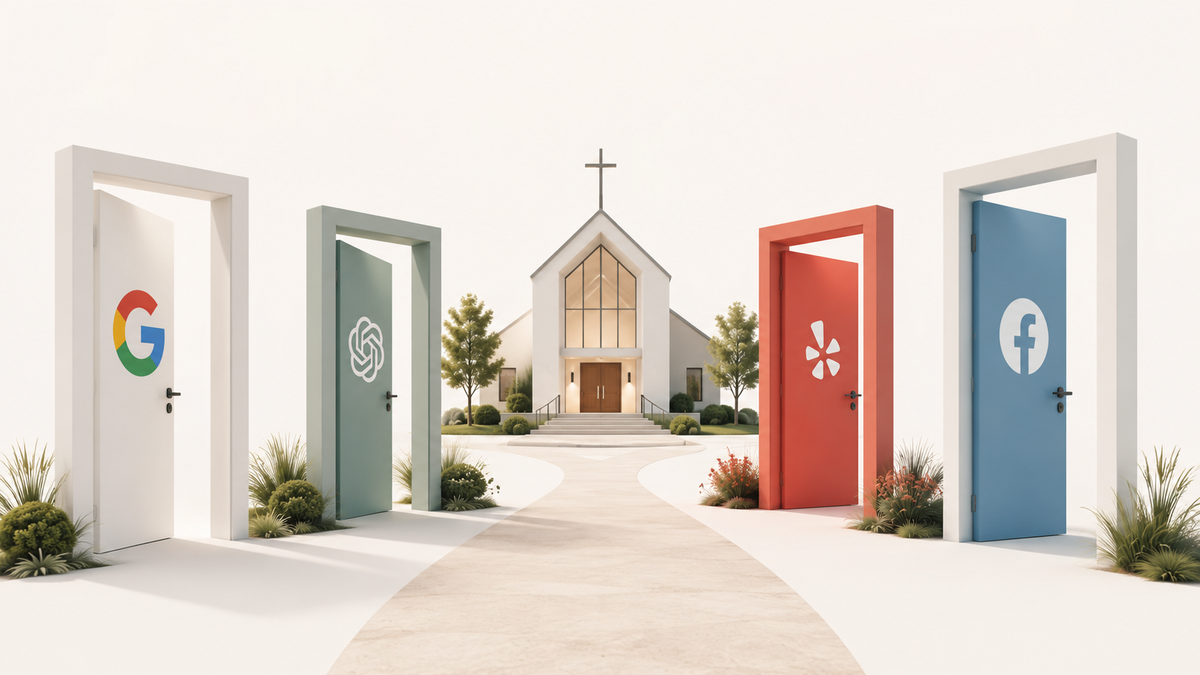
There are a whole lot of digital doors people can walk through before they get to your website.
Think about what happens when someone visits your church for the first time.
They pull into the parking lot. They look for signage. They figure out which entrance to use. They walk through the doors.
Then they reach the lobby.
That’s where they can figure out where their kids go. They can learn about small groups. They can ask a volunteer a question. They can find information about an upcoming event or figure out what their next step should be.
Your digital presence works similarly.
For years, church marketers and website designers have repeated the same phrase:“Your church website is your digital front door.”
I understand what they mean. And there’s some truth to it.But I don’t think it accurately describes how people find churches anymore.
By the time someone reaches your website, they may have already seen your church on Google Maps, read three reviews, watched an Instagram Reel, asked ChatGPT about churches in the area, or seen your name mentioned somewhere else online.
Those interactions happened before they reached your website.
Your church doesn’t have one digital front door anymore.
It has dozens of them.
And your website has a different job.
Your Church Website Is the Lobby
Think about the purpose of your church lobby.
Once someone gets inside, the lobby helps them understand where to go next.Your website should do the same thing.
Someone lands on your website and wants to know:
- When do you meet?
- What do you believe?
- What should I expect?
- Where do my kids go?
- Do you have something for teenagers?
- What kind of small groups do you have?
- Who is the pastor?
- How do I get involved?
- How do I ask for prayer?
Those are lobby questions.
And a good church website answers them without making someone dig through six dropdown menus, watch a welcome video, and solve a scavenger hunt.
That means I’m not diminishing the importance of your website here.
Quite the opposite.
Your website should probably be the most complete source of information about your church online.
But being the most complete source of information and being the first place someone encounters you are two different things.
That distinction matters.
Because if you only care about your website, you’re ignoring all the places someone might encounter your church before they ever reach it.
Your Church Has More Digital Front Doors Than You Think
There isn’t one universal journey people take to find a church anymore.
Someone might search “churches near me.”
Someone else might see a Reel their friend shared.
Another person might ask Gemini for a church with a good kids ministry near them.
Someone else might see your church mentioned in an article about a food drive.
All of those can become an entrance into your digital presence. So if you want your church to become easier to find online, you need to pay attention to the entire property — not just the lobby.
1) Google Business Profile
This is probably the most obvious digital front door.
Someone searches for “church near me,” “churches in Fort Worth,” or another local search, and your church can appear before they ever see your website.
- They see your name.
- Your reviews.
- Your photos.
- Your location.
- Your category.
- Potentially your hours and other information about the church.
And increasingly, Google doesn’t even need someone to click through ten websites to find information about local places. Google Maps now has "Ask Maps," which uses Gemini to answer conversational questions about places, while Gemini itself can use public Google Maps information to provide details about a place. This changes the role of your Google Business Profile.
It isn’t merely a citation you set up five years ago because some SEO guy told you to.
It is part of your church’s first impression.
Make sure the church name is accurate. Use recent photos that actually represent what someone will experience. Check your categories, website, phone number, and other information.
And be careful with hours. Google specifically notes that organizations with varying schedules, including worship services, may not fit neatly into normal business-hour fields.
“Special Hours” are intended for temporary changes such as holidays or special events, not as a workaround for recurring Sunday services. Service times still need to be easy to find — especially on your website — but accuracy matters more than forcing information into the wrong field.
Your Google presence should make someone more confident about visiting your church, not more confused.
2) Yelp
Yep. Yelp.
I don’t particularly enjoy telling churches they need to pay attention to Yelp either, but here we are.
In July 2026, Yelp entered a partnership with OpenAI that gives ChatGPT access to Yelp reviews, ratings, photos, and other local business information. This should change how you think about seemingly forgotten profiles around the web.
You may not personally use Yelp to find a church.That doesn’t mean the information sitting there is irrelevant.
Claim the profile (if you can). Make sure the information accurately represents your church. Add good photos. And while I would still prioritize Google for church reviews, don’t completely ignore Yelp as another place where real people can talk about their experience with your church.
This is part of a much bigger shift.
Third-party information about your church matters because you are no longer the only one telling your story.
3) ChatGPT, Gemini and AI Search
Here’s where things get really interesting.
People can now ask questions like:
- “What’s a good church for young families near me?”
- “Are there any churches near me with an active young adult ministry?”
- “What does this church believe about baptism?”
- “What church should I try if I haven’t been to church before?”
Those are very different searches from simply typing “church near me.”
And your goal should not be to somehow manipulate ChatGPT into recommending you for every possible church question.
(Please don’t.)
Your goal should be to make it incredibly clear who your church actually is and who you are best equipped to serve.
If you have an incredible kids ministry, prove it.
Create a useful kids ministry page. Answer the real questions parents ask. Show photos. Explain security and check-in. Introduce the people leading it. Talk about what children are learning.
If your church has a thriving young adult ministry, do the same thing.
If recovery ministry is something your church is exceptionally equipped to offer, make that clear.
Don’t create 77 meaningless FAQs because somebody told you that FAQs are good for AI.
The robots aren’t your congregation.
Help people first.
Clear, specific, and truthful information gives search engines and AI systems much better material to work with anyway.
The future of church visibility isn’t stuffing more keywords onto a page. It’s giving machines enough accurate information to understand what humans already experience when they encounter your church.
4) Social Media
Social media is another obvious front door, but I think churches often misunderstand its job.
Your church’s Instagram account does not need to become a bulletin board.
If all I see are event graphics, sermon-series graphics, and reminders that Wednesday night starts at 7, I haven’t learned much about your church.
- Show the people.
- Show what God is doing.
- Show me the sermon snippet that answers a real question someone is wrestling with.
- Show volunteers serving your city.
- Show baptisms.
- Show young adults gathering together.
- Show what children’s ministry actually looks like.
If your church says it cares about the community, show the church caring about the community.
And you don’t have to be everywhere.
If your congregation and the people you’re equipped to reach are primarily on Facebook and Instagram, be excellent there.
You don’t need to start a TikTok account simply because someone said churches need TikTok.
A neglected social profile with outdated information may actually make the front porch look worse.
Be where your people are. And when they find you, give them an honest picture of who you are.
5) Reddit and Online Communities
This one is a little different.
I’m not suggesting that your communications director create a fake Reddit account and start commenting:
“Hello fellow Fort Worth residents! Have you considered visiting First Generic Church? We have AMAZING worship!!!”
Please don’t do that.
But you should know what people are saying.
- Search Reddit for conversations about churches in your city.
- Look at local Facebook groups.
- Look at neighborhood forums and community conversations.
You may discover that people are already talking about your church.
Or you may find people asking questions your church is genuinely equipped to answer.
Those conversations matter because this is what word-of-mouth looks like online.
Your website tells people what you say about your church. These communities tell people what other people say about your church.Both matter.
6) Church Directories
Then there are all of those random church directories scattered around the internet.
Church Finder. FaithStreet. Denominational directories. Local ministry directories. And probably a few websites you’ve never heard of that somehow have your church’s old phone name from 2004.
These are easy to ignore because very few church leaders wake up excited to optimize their Church Finder profile.
I get it.
But these profiles create another collection of signals about who your church is, where you’re located, and how someone can reach you.
At minimum, check the important ones and make sure basic information is consistent.
- Your church’s name.
- Address.
- Phone number.
- Website.
- Denomination or church tradition where applicable.
- Basic descriptions.
You may hear an SEO person call this “NAP consistency” — Name, Address, and Phone Number. Someone should not find different phone numbers or your church's previous name.
Again:Clarity builds trust.
7) Local Media and Community Websites
This might be the most overlooked front door on the entire list.
What does the rest of your city say about you?
- Maybe your church hosted a food drive, and the local newspaper covered it.
- Maybe you partnered with a school.
- Maybe the Chamber of Commerce lists you.
- Maybe a local nonprofit thanked your church for volunteers.
- Maybe a community organization has your church listed as a partner.
Those mentions do something your About page can’t.
They confirm what you say about yourself.
Any church can put “We love our city” on its homepage.
It means a little more when the local food bank is talking about the 150 church members who showed up to serve.
That matters to people. It matters to search engines. And as AI systems synthesize information from more places around the web, having credible sources that reinforce who you say you are becomes increasingly important.
You shouldn’t serve your city because you want a backlink.Let’s make that extremely clear.
You serve because you’re the Church. But if you’re already doing meaningful work in the community, don’t hide it. Let people tell those stories.
Your Website Still Matters — A Lot
If you’ve made it this far, let me reassure you: your website is incredibly important. In fact, it is one of your church’s most valuable tools online and deserves your full attention.
Your website matters tremendously.
In fact, all these different front doors make a good website more important.
Because eventually, people need somewhere to go.
They need the lobby.
Your Google Business Profile isn’t going to explain your theology adequately.
An Instagram bio isn’t going to walk a nervous parent through children’s check-in.
A Yelp profile shouldn’t be your primary source for service times.
And ChatGPT should not be the authoritative source on what your church believes.
Your website should be the source of truth.
It should contain enough useful, specific information that Google can understand you. It should make is easy for AI systems should represent you accurately.
And, most importantly, actual human beings can decide what their next step should be.
That’s why traditional church SEO still matters.
- Have clear pages.
- Write useful copy.
- Build pages for real ministries instead of giving every ministry two sentences on one giant page.
- Keep information updated.
- Use internal links to help people move through the site.
- Answer people’s questions.
- Publish useful content.
- Make service times easy to find.
And please make sure someone can figure out where you’re located. The fundamentals haven’t disappeared.
They’ve become part of a much larger ecosystem.
Stop Optimizing a Website.
Start Building Visibility.
This is the mindset shift I want churches to make.
Stop thinking:“How do we get our website to rank?”
Start thinking:“When someone looks for a church like ours, what do they find?”
Those are not the same question.
Search your church name. Search for churches in your city. Look at yourself on Google Maps. Look at your reviews. Search Reddit.
Look through your social media like you’ve never heard of your church before.
Ask ChatGPT about your church. Ask Gemini.
Look at church directories.
Then go deeper.
Search the kinds of questions the people you’re best equipped to serve would actually ask.
If you’re trying to reach young families, what happens when you search for churches with kids ministries?
If you have a strong recovery ministry, what information appears when someone is looking for Christian recovery resources nearby?
If your church wants to reach college students, what does the internet actually say about your church and college students?
And then ask one final question:
If someone knew nothing about our church except what they found online, would they get an accurate picture of who we are?
That’s the goal. Not gaming Google. Not manipulating ChatGPT. Not showing up everywhere for everyone.
You want your church to be visible to the right people when they find you.
Your website plays a massive role in that. But it’s not the front door. It’s the lobby. And there are a whole lot of doors people can walk through before they get there.