[NEW] The State of Church SEO
Key Findings
- Average Map Pack reviews: 180 (median: 137)
- Average rating: 4.74 stars
- 61% include a city keyword in their meta title
- 60% use some form of schema markup
- 66% have a sermon library — only 22% have a blog
- Average backlinks: 637 (median: 230)
- 72% of all ranking churches are non-denominational
- Only 10% have active Google Business Profile Posts
- 27% have a clear first-time visitor CTA (“Plan a Visit” / “I’m New”)
“What actually causes a church to rank on page one of Google?”
I wanted to dig deep and find out what makes a church show up on page 1. What are the actual signals that matter?
This report, the State of Church SEO 2026, was born of a need to cut through the noise.
And the answer to that question, as this data reveals, is not theological—it’s structural. Our analysis revealed a surprising reality: 72% of all page-one ranking churches are non-denominational.
To identify the exact reasons behind this visibility gap, we analyzed 100 churches across 21 U.S. cities.
We systematically broke down what these winning churches are doing across their Google Business Profiles, websites, and backlink profiles.
The most critical finding for any Pastor or Communications Director short on time is this: The churches ranking on page one aren’t performing advanced SEO. They are simply executing the high-impact fundamentals with unmatched consistency.
This data is the blueprint for simple, low-time-commitment solutions that deliver immediate results.
You are about to discover the structural advantages that leading churches leverage in local search. This report will show you exactly where to focus to achieve high-probability ranking success:
- Why 72% of all ranking churches are non-denominational, and the simple Google Business Profile fix for denominational churches.
- The median review count (137) and rating (4.74 stars) required to be competitive in the Map Pack.
- The widespread technical failure of internal linking (affecting 85% of churches) and the straightforward way to fix it in minutes.
- The five highest-impact, low-time-commitment changes your church can make to stand out from the 90% that are leaving free promotional channels completely unused.
Methodology
Search Approach
For each city, I searched:
- “church in {city}”
- “churches in {city, state}”
From each search, I recorded:
- The top 3 churches in the Map Pack
- The first 2 organic results (excluding duplicates)
That gave me 100 churches across 21 cities — with both local and organic representation.
Data Collected
For each church, I analyzed:
- Google Business Profile (reviews, rating, category, posts)
- Website structure (meta title, headings, page count)
- Content (blogs, sermon libraries, ministry pages, CTAs)
- Technical SEO (schema usage, internal linking)
- Backlinks (estimated referring domains)
- Denomination and platform
This made it possible to identify patterns, not just isolated examples.
SECTION I — MAP PACK & LOCAL SEO
What Actually Gets a Church into the Map Pack?
Google Business Profile (GBP) is the foundation for local visibility. Your GBP is the right hand panel that shows up when you Google your churches. It’s also what Google Maps uses to display your business.
The data here is clear.
Review Volume Matters (A Lot)
Average reviews: 160
Median reviews: 112
You don’t need thousands of reviews to compete.
But you do need to clear a threshold.
In most metros, that threshold sits somewhere between 100–150 reviews.
- Below that? You’re at a disadvantage.
- Above that? You’re competitive.
The good news: churches have a built-in advantage here.
Deep community relationships, repeat attendance, and meaningful personal experiences generate authentic reviews organically — in a way most local businesses can’t manufacture.
Whitespark’s 2026 Local Search Ranking Factors report reinforces this: recency now matters almost as much as volume. A steady flow of new reviews outperforms a one-time burst followed by silence. Which means consistent ask-and-receive beats a seasonal push every time.
How can you get more reviews more consistently? One idea is to include in your new member class or volunteer team onboarding. It doesn’t hurt to ask people for a review. What you don’t want to do is ask the entire congregation to leave one during service.
Google would see a bunch of people suddenly leave a review from the same location, and it could shut down your GBP for potential spam.
Rating Consistency
Average rating: 4.7 stars
This is nearly universal across every city in the dataset.
Maintaining a high rating is the baseline. If yours is below 4.5, that’s worth addressing before anything else. Take note of the review idea in the previous section.
GBP Primary Category: The Most Underrated Factor
Your primary category is the number one ranking factor for your Google Business Profile.
As I analyzed 100 churches, here’s how the primary categories break down across the dataset:
- Church — 38.3%
- Non-denominational church — 23.3%
- Christian church — 11.7%
- Other categories — remaining
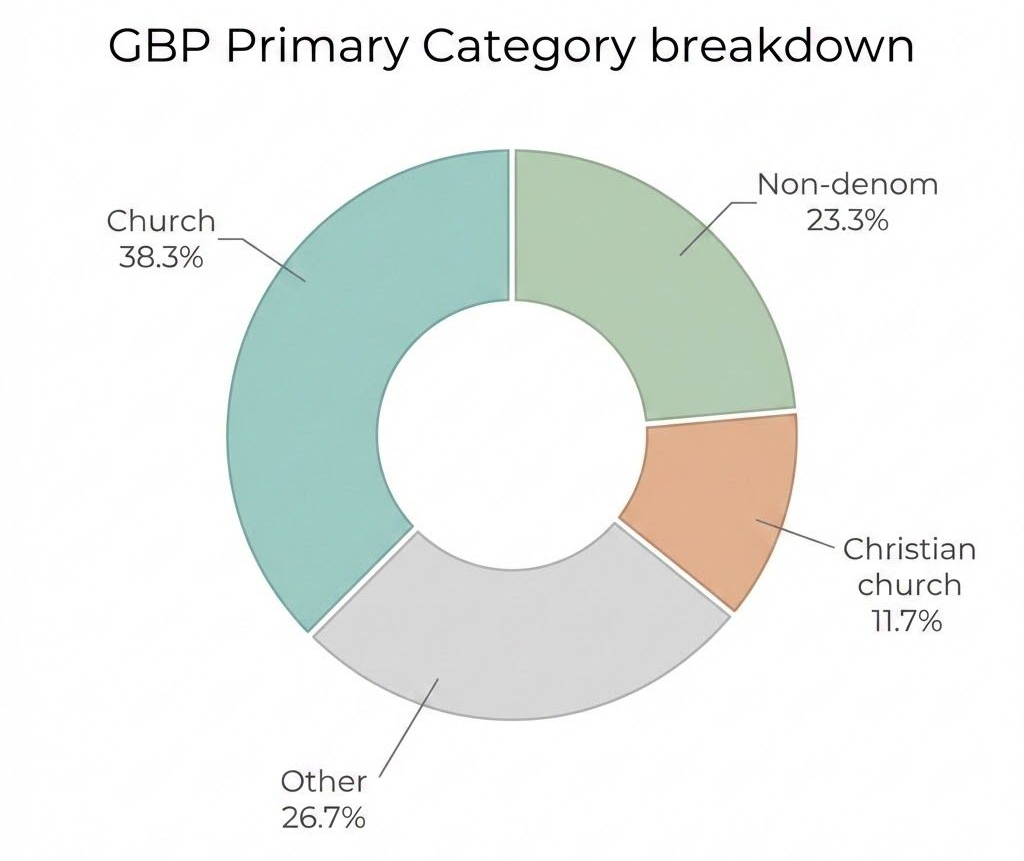
This is one of the clearest signals you need to understand to rank your church online.
Your primary category directly influences what you rank for.
Want to rank for “church near me”? → Use “Church”- Want to rank for denominational searches? → Use your denomination (methodist church, baptist church, etc.)
Most churches don’t think strategically about this.
But it’s one of the fastest changes you can make with a real ranking impact.
Don’t be afraid to test one week changing from church to your denomination or vice versa.
GBP Posts: A BIG Missed Opportunity
Only 10% of churches have active GBP Posts.
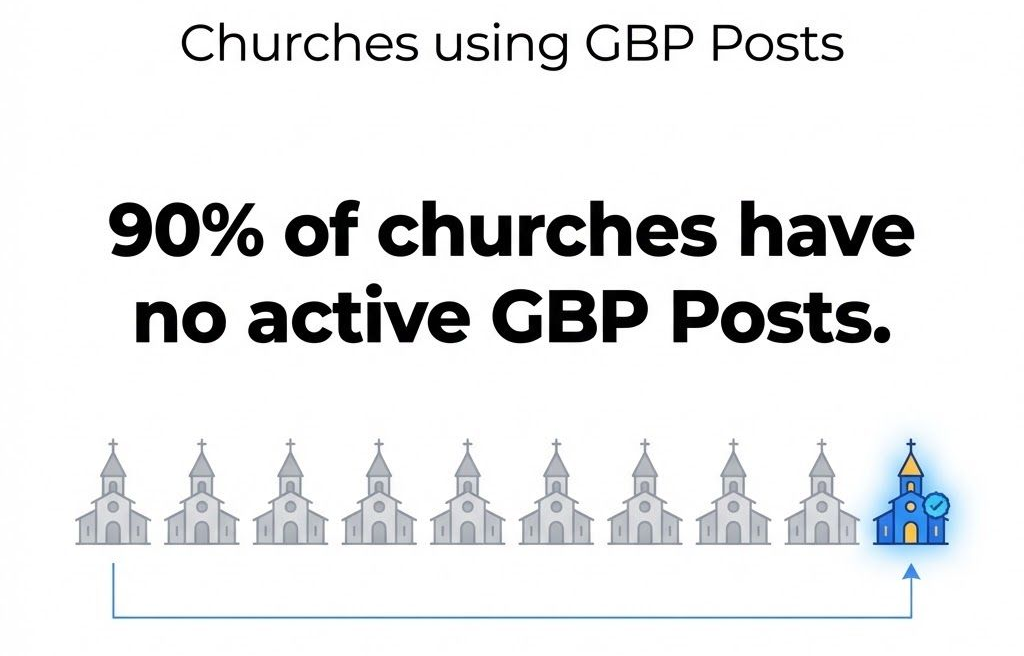
That means 9 in 10 churches are leaving a free promotional channel completely unused.
GBP Posts let you publish events and community announcements directly inside your Google listing.
Whitespark’s 2026 report is explicit: engagement signals — posts, photos, clicks, calls, direction requests — are increasingly influential ranking factors.
Posts themselves barely move the needle. But Google rewards profiles that look alive.
Not profiles that were set up once and left alone.
This is a high-ROI improvement most churches can make. One post per week — an upcoming event, announcement, etc — is enough to stand out from 90% of other churches.
Business Name Optimization
Only 24% include the city in their church name.
Which means 76% do not.
This goes against a lot of traditional local SEO advice.
Including the city can help — but the data shows it isn’t required.
Most ranking churches aren’t doing it.
But, if you’re a potential church planter, consider naming your church “{City} Church” or something like “ Revival Church of {City}”
Geo Keywords in Title Tags
61% include a city keyword in their meta title. 39% do not.
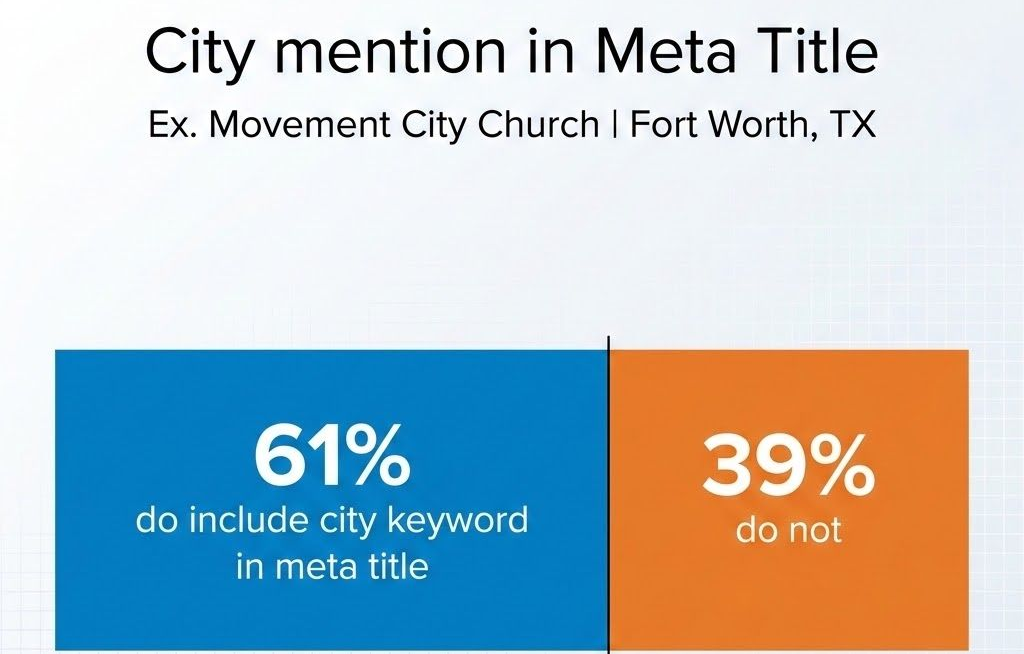
Strong correlation. Not universal — but common.
If your homepage title doesn’t include your city, that’s a quick win.
It takes no time to fix.
Having your geo-specific keywords in your title tag, and in other content on your website, are strong indicators for local rankings (and AI visibility).
SECTION II — CONTENT STRATEGY
Most churches ranking organically aren’t doing “perfect SEO.” But they are doing enough.
The next level of SEO work they can do is leverage their existing Sunday content.
Sermon Libraries vs. Blogs
66% have a sermon library. Only 22% have a blog.
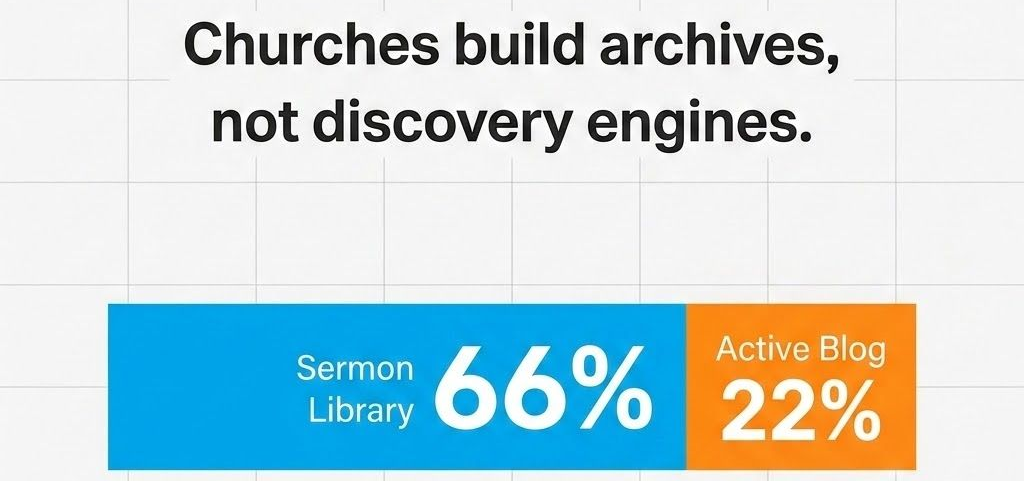
This is one of the biggest gaps in the entire dataset.
Churches are consistently producing content.
They’re just not structuring it for search.
Sermon libraries serve the people who already know you.
Blogs are what rank for the people who don’t.
Whitespark’s 2026 report backs this up: Google’s AI systems now lean heavily on well-organized on-site content to match a business to local search intent.
For churches, every unanswered question is a missed ranking opportunity.
Someone searching “how to find a new church” or “Bible studies near me” won’t find your sermon video from three weeks ago.
But they might find a well-written blog post… or ministry page.
Ministry Pages: Structure Matters
Average: 6 > ministry pages per church.
Majority of the churches on that showed up on this list were large churches. They certainly have more than 6
actual ministries going on.
But only have an average of 6 pages for your ministries is astoundingly low.
It leaves long-tail keyword opportunities on the table. It makes Google have to assume or AI have to make up random information.
Ministry pages also allow for different keywords for each distinct audience with specific search intent:
- “youth group [city]”
- “women’s Bible study near me”
- “grief support group [city]”
- “recovery ministry [city]”
- “Wednesday night church”
Churches that rank well tend to have dedicated ministry pages with clear structure:
- answering who it’s for
- what happens
- when it meets
- how to get involved
That clarity helps both users, search engines, and AI.
SECTION III — TECHNICAL SEO
What’s Happening Under on the back end of your website?
Schema Markup
Schema tells Google (and AI systems) the structured facts about your church — location, service times, organization type.
60% use schema. 40% do not.
Which means there’s a real edge available here. If you have a site built on WordPress, it’s really easy to have Schema added. I know Squarespace also makes it easy.
Whitespark’s 2026 report adds that schema is now foundational for AI-driven results. Without it, AI search can have a harder time understanding and recommending you.
Most churches without schema either haven’t thought about it, or set it up incorrectly.
Either way, it’s fixable — and it’s one of the clearest technical edges available. Learn more about schema markup here.
Internal Linking
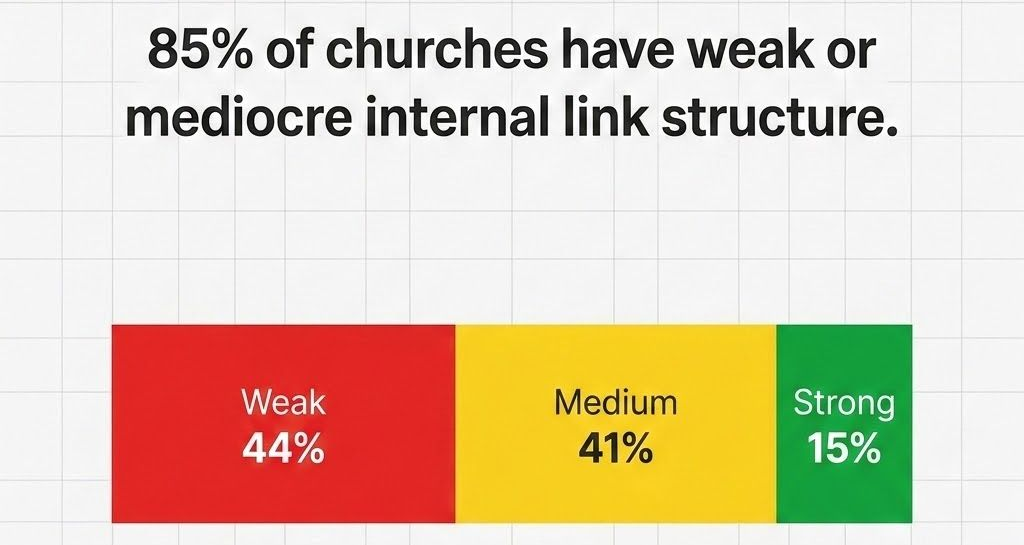
85% of church websites have weak or mediocre internal linking.
Internal linking are links within the content that go to other pages on your website. It’s what allows a user to go from your home page, to your beliefs page, to your kid min page seamlessly. And, no, this isn’t just have the navigation bar at the top.
It’s also how authority flows through your site.
A homepage that earns authority from backlinks and GBP signals needs to pass that authority to your sermon library, your ministry pages, and your visitor info page.
Only 15% have strong internal link architecture. Meaning, very few churches make it easy for people to go from one page to another (excluding the navigation menu).
Here’s why that matters:
If those pages aren’t being linked to contextually, they’re (basically) isolated.
Isolated pages don’t rank.
The fix is straightforward: make sure your high-traffic pages link to your most important destination pages. Sermon descriptions, blog posts, and event pages are all natural places to add those links.
Website Platform
How you use a website platform matters more than the platform itself.
Still, I wanted you to know what the general website landscape looks like.
The CMS landscape breaks down like this:
- WordPress — 29%
- Squarespace — 19%
- Subsplash — 13%
- Wix — 6%
- Rock RMS — 5%
- Webflow — 4%
- The Church Co — 4%
- Other — 20%
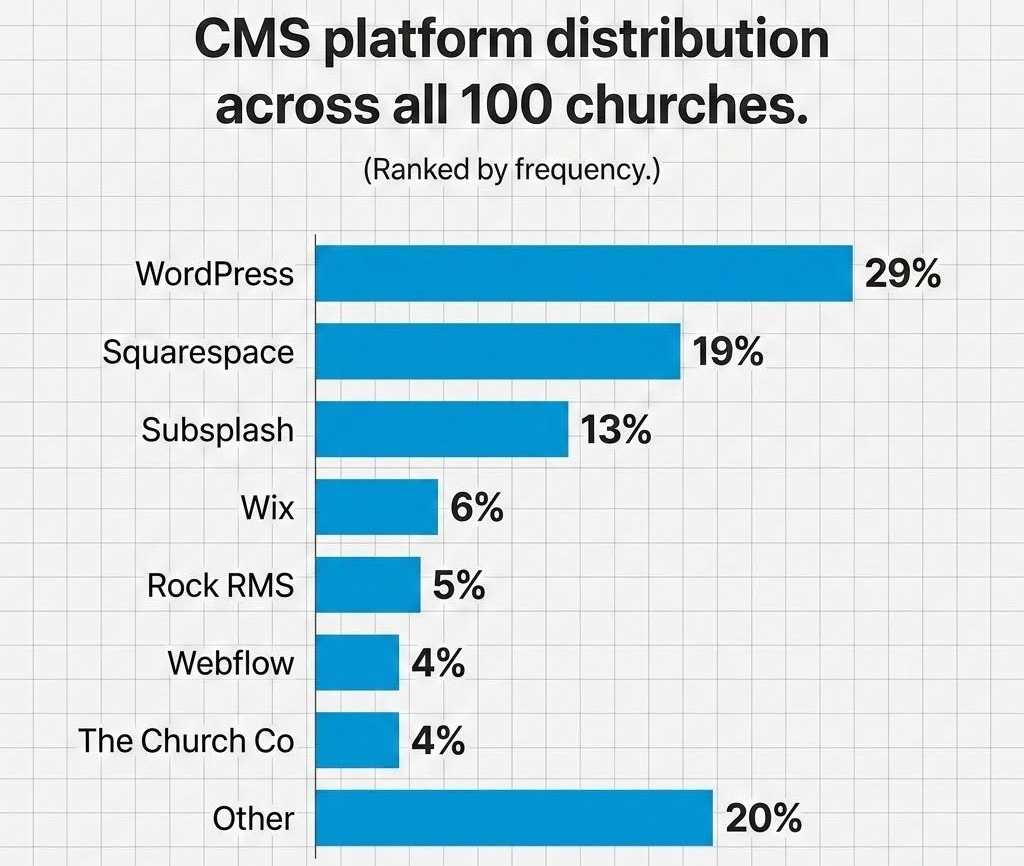
WordPress gives the most technical control. Subsplash trades flexibility for church-specific features. Squarespace and Wix are built for ease.
What matters most: whether your team is actually using the SEO tools available to them, and ensuring whoever is managing the site is using SEO best practices.
SECTION IV — BACKLINK ANALYSIS
Do Backlinks Matter for Churches?
A backlink is any website that has a link to your church’s website.
And, yes, they matter.
But not in the way most people expect.
Overall Profile
- Average backlinks: 637
- Median backlinks: 230
The median is what matters here.
Averages get pulled up by large churches with outsized link profile, likely from press (Good/bad), social media, and other endeavors.
The median tells you what’s actually typical.
And the real benchmark is around 200–230 referring domains.
That’s your target — not 637.
Where Are These Links Coming From?
The quality links (and I put a big emphasis on quality), come from
- Local directories
- Denominational websites
- Event listings
- News features
- Community partnerships
Whitespark’s 2026 report is consistent with this: citation
quality beats citation
quantity.
Ten links from authoritative local sources outperform fifty from low-quality directories.
Churches naturally earn links from high-trust, geographically relevant sources.
That’s exactly what the algorithm rewards.
So do something that is worth talking about. Share about your local mission work, your volunteerism. Have people share their stories of how you blessed them. Tell local media organizations about them (newspapers, magazines, mom blogs, etc.)
SECTION V — DENOMINATIONAL BREAKDOWN
72% of all ranking churches are non-denominational.
That’s one of the most striking findings in the dataset.
Denominational churches are significantly underrepresented.
Why This Is Happening
A few likely reasons:
- Category strategy. Non-denominational churches typically select “Church” as their primary GBP category — the broadest, highest-volume option. Denominational churches often use a specific category that limits their visibility for generic searches.
- Brand positioning. Non-denominational churches tend to optimize for accessibility — in name, messaging, and digital presence. That broader positioning translates to broader keyword coverage.
- Digital investment. Non-denominational churches tend to invest more heavily in marketing and digital infrastructure.
This isn’t a theological issue.
It’s a visibility issue.
And it’s fixable.
Test out changing your Google Business Profile’s primary category to “church” and see how it affects your visibility for a few weeks.
SECTION VI — DESIGN & CONVERSION
What Happens After Someone Finds You?
SEO gets someone to your site.
What happens next is a different question entirely.
Design Quality
69% of church sites lean modern. 24% lean outdated. 6% are somewhere in between.
Most churches have made the investment in a current presentation.
But nearly 1 in 4 haven’t.
For a first-time visitor, an outdated site is a credibility signal.
Often, it’s enough to make them leave.
The Call-To-Action (CTA) Problem
Your CTA doesn’t directly affect SEO. But, people clicking it show engagement on your website. Google rewards websites where visitors are active on the site.
61% of churches have some kind of homepage CTA.
But what that CTA says — and who it’s actually for — varies a lot.
27% have a genuine new-visitor CTA.
Language like
- “Plan a Visit”
- “I’m New”
- “New Here?”
directly addresses someone considering their first visit.
21% use digital engagement CTAs.
- “Watch Online”
- “Stream Live”
- “Watch Now”
Useful for existing members. Not built for inviting first-time in-person visitors.
39% have no identifiable CTA at all.
No invitation. No next step. Nothing.
The pattern is clear:
Most church homepages are built for the congregation they already have.
Not for the people they’re trying to reach.
SECTION VII — AI & FUTURE SIGNALS
Are Churches Ready for AI Search?
Short answer: not really.
Most churches:
- Upload sermon videos but don’t structure content for search
- Don’t answer common faith questions in writing
- Use headings inconsistently or not at all
AI search — Google’s AI Overviews, ChatGPT, Perplexity, etc — favors:
- Clear, structured content with direct answers
- Schema markup that gives context to machines
- Consistent review sentiment and business information
- Citations from authoritative local sources
Whitespark’s 2026 report introduced an AI Search Visibility category for the first time. The signals that drive it overlap heavily with traditional local SEO — but structured content and schema carry significantly more weight.
Churches are sitting on years of content.
Almost none of it is packaged in a way AI can use.
SECTION VIII — WHAT WILL MOVE THE NEEDLE
Based on everything analyzed, these are the patterns that showed up consistently across ranking churches:
- Review count above ~137
- Rating above 4.7
- Correct GBP primary category
- City keyword in meta title
- Active GBP Posts
- Basic schema implementation
- Backlink profile above ~200 referring domains
- Dedicated ministry pages with clear structure
- A clear new-visitor CTA
None of this is advanced.
But it’s consistent.
And consistency is what separates ranking churches from everyone else.
SECTION IX — STRATEGIC RECOMMENDATIONS
Where to Focus Based on Where You Are
If You’re a Church Under 200 People
Keep it simple. Focus on:
- Reviews — build a consistent ask-and-receive process
- Title tag — add your city if it’s not there
- GBP Posts — one per week, any format
- Basic site structure — clear navigation, mobile-friendly
- Claim all profiles — Google, Yelp, Apple Maps, Bing
You don’t need a massive site.
You need a clear one.
If You’re a Multi-Campus Church
You need location-specific strategy, not one-size-fits-all:
- Campus-specific pages with local keywords
- Separate GBP listings per campus
- Internal linking that connects campuses without diluting local signals
Treat each campus as its own local entity.
Because that’s how Google sees it.
If You’re a Denominational Church
You’re starting at a disadvantage — but it’s fixable.
- Review your GBP primary category — “Church” may serve you better than your denomination
- Include “church” in your name or title tag if it isn’t there
- Optimize for broad keywords, not just denominational ones
The gap isn’t theological.
It’s structural.
Structure can be fixed.
Limitations
This study isn’t perfect.
- Backlink data is estimated, not exact
- No heatmap or user behavior data
- No organic traffic data analyzed
- No controlled experiments — this is correlation, not causation
But the patterns are consistent across 100 churches and 21 cities.
Conclusion
Most churches are not competing in SEO.
Which means if you do
basic SEO well, you can win.
The gap between ranking churches and non-ranking churches isn’t massive.
It’s structural.
And structure can be fixed.
If your church isn’t showing up online, it’s not because people aren’t searching.
It’s because your church isn’t sending the right signals.
And once you understand those signals, you can change that.
Find this helpful? Share with someone who would benefit!